



























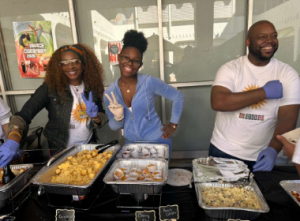
FEB 20—Black Student Union (BSU), in collaboration with Black Parents Union (BPU), hosted a food festival on Friday on the second-floor patio. Members of both organizations worked side by side to pass out food to a long line of excited students, with a menu full of savory main dishes and sweet desserts, each made with love and care.
Friday’s food festival was particularly significant as it celebrated the 100th anniversary of Black History Month. What we used to celebrate was a week in 1926, known then as “Negro History Week.”
Negro History Week was originally chosen to be on the second week of February, because that week coincided with both Abraham Lincoln’s birthday (February 12th) and Frederick Douglass’s birthday (February 14th), both of whom were celebrated figures by the black community.
This week was launched by historian Dr. Carter G. Woodson and the Association for the Study of Negro Life and History, and they passed out teaching kits that focused on the Abolitionist Movements, black inventors, and more.
Woodson’s vision focused on inclusion; he famously said, “We should emphasize not Negro History, but the Negro in history. What we need is not a history of selected races or nations, but the history of the world, void of national bias, race, hate, and religious prejudice.” By the 1960s, the week expanded to a month and was officially recognized by the United States government in 1976.
In honor of Black History Month, BSU and BPU brought the spirit of the month to life on our campus. By organizing a food festival, they brought students together for an afternoon of delicious food and meaningful connection.
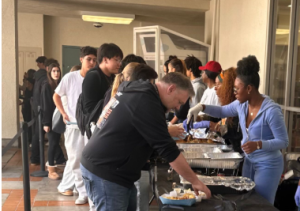
“Taste of Soul was an opportunity for [us] to share a little piece of black culture with the school. We brought different soul food dishes that are traditionally found and made in black households and restaurants,” said Senior BSU President Makinzi Gregory.
BPU brought fried chicken, mac and cheese, jollof rice, corn bread, potato salad, and apple pie. All of these foods have cultural significance to Black American culture. For example, mac and cheese was introduced to the US by James Hemings, who was taken to France for culinary training during his enslavement. He went on to become a celebrity chef at Monticello, a plantation farm of Thomas Jefferson. Hemings adaption of the dish helped to popularize it amongst Black American households to this day.
BPU member Samson Odede said, “I strongly believe that apart from enjoying the wonderful, yummy taste, the students will realize the cultural heritage of the origin where the food came from.”
“I loved the Taste of Soul food festival: the music, the warmth of the volunteers, and the enthusiastic students waiting to try the food all made this event feel welcoming. I really liked the mac and cheese they served. It tasted warm and rich, and I would definitely have it again,” said sophomore Bryan Xu.
As the students enjoyed their food, this showed that the Taste of Soul food festival was more than just a meal: it was a powerful reminder that celebrating our diverse cultures and histories is what truly strengthens our community.